Welcome!
I’m Bandana (Bun-the-nah), a Sr. Strategic Designer based in Toronto, Canada. Thank you for considering me to join your team. This site is best viewed on desktop, in chrome.
This site is best viewed on desktop and not optimized for mobile.
Please Note Privacy & Confidentiality Terms.
Download my resume.
Review client testimonials.
See my contact info.
Projects on the Go! (a/o Mar 2026):
Foundational research project for AI product development in EdTech. (United States)
Inclusive strategy for national marketing campaign for multinational commercial food brand. (Canada)
Designing research and program for a micro investment fund for artists. (Canada)
Sr. Strategic Designer with 8 years experience leading complex, high ambiguity projects using human-centered design projects.
Expertise in leading public sector projects with high sensitivity (digital and service/program) at scale from 0-1 through to implementation including government, philanthropy, non-profit and cultural/creative industries.
Freelancer/Consultant working in the US and Canada based in downtown Toronto.

Service
Brampton, Canada, 2018-2020 (In house role: In-person + remote during Covid)
Design Research, Design Strategy, Service Design Rebrand
THE IMPACT
In only 18 months, the Community Grant Program was transformed into the Advance Brampton Fund, increasing funding, skills training and accessibility to the City of Brampton’s largest and most impactful granting program. The redesign enabled:
A clear, easy to follow, streamlined service experience across online and in-person services for applicants, administrators and publicly elected Council members.
Created a holistic impact framework that ties the impact of funding projects directly to city-wide strategies.
Created successful business case for long-term FTE hire and ongoing funding for skills training for non-profits
A stable framework furthering investment and growing the fund from $1.5M (2019) to $1.75M (2025) CAD and impacting 250,000 ppl in the city each year.
OPPORTUNITY SPACE
The City of Brampton in 2018 was growing at a rate of 13% year over year. It had recently ratified it’s Culture Master Plan, a first in the city’s history. A major pillar of the plan was redesigning the $1.5M CAD Community Granting program that served arts, sports and tourism in order to ensure growth of the non-profit sector, a sector that itself also needed ongoing skills support.
I led a team of 6 staff, and 10 departments through the redesign while still maintaining the live program. Activities included design research, strategic recommendations, the grant portal procurement and design, the service design of the program experience and design of the non-profit sector development program (an ancillary program to the funding itself).
Visual of the redesigned Advance Brampton Fund community granting framework. Program details provided below.
APPROACH
After the discovery period, it was determined that:
The fund needed to undergo a radical redesign at a systems level ensuring that the underpinning program framework could meet the new needs of the Culture Master Plan;
Design research using participatory methods (a new approach for the city) would ensure the needs of an extremely diverse city were clearly centered in the program;
Using strong service design principles for public service (the British Columbia Service Design PlayBook as a guide) to ensure that a compliance heavy program like public funding could still be personable, and administered effectively in a timely manner by city staff.
We would not close the program while doing the redesign. We were going to run the redesign project parallel to the open granting program that was servicing grantees. The workplan was phased to ensure that during the highest intensity times of the open program were prioritized.
INSIGHTS , STRATEGY & PROTYPING
Through the design research experience, and while administering the granting program, both user/applicant and staff/systems tensions and opportunities began to surface. Select insights are below:
USER/APPLICATION PAIN POINTS
The lack of coordinated systems across 10 city departments made delivery of the program overly complex for internal staff to deliver.
Fewer than 10 organizations who were long-standing applicants were awarded nearly 50% of the entire fund. With an evaluative framework that was difficult to compare ‘apples-to-apples’ evaluators found it difficult to trust new-entrants with smaller projects as much as long-standing, larger projects.
Too many grantee organizations were non-compliant with reporting. These were small non-profits that were doing their best to provide services while meeting the extensive reporting needs that public granting demands. This was in part due to the extensive “legalese” that made it difficult for even internal staff to clearly understand what was being asked and why.
The Community Granting portion was rebranded as Advance Brampton Fund with refreshed visual identity and logo to separate it clearly from Festivals and Tourism.
A main landing page with images of the types of activities being funded by all of the City’s different granting programs was created to help people navigate quickly to information most relevant to their projects.
Extensive in-person information sessions were held to support people in understanding the refreshed framework and how to apply.
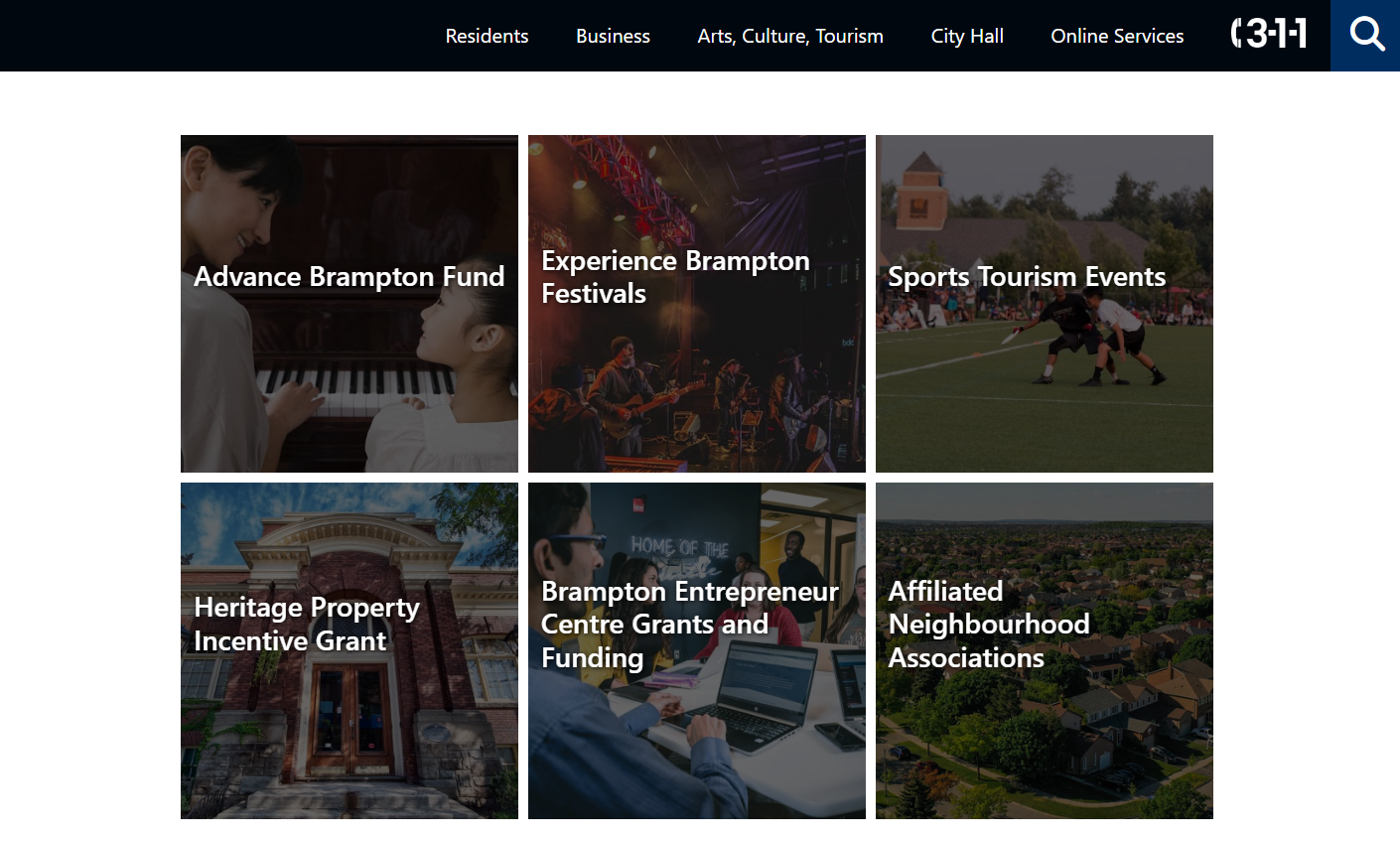
PROGRAM FRAMEWORK
Then, within the Advance Brampton Fund specifically, the program framework acts like a stepping-stone experience, from Micro grants under $5000, to Amplifying grants up to $25000, ensuring that as projects do get larger, there is a clear next step for organizations, so that they don’t unintentionally compete against smaller entrants who are just gaining steam.
For larger organizations in the Developing and Amplifying streams, there is the opportunity to grow with multiple year funding for the same project. Through the extensive research and engagement phase, a business case became clear for a FTE Program Manager dedicated to the fund to act as a pivot point between internal divisions and applicants/grantees.

TEAM:
Bandana Singh,
Strategic Projects and Design Lead, CGP - Cultural Services & Economic DevelopmentPublic Documentation
Advanced Brampton Fund - main website
All images copyright of City of Brampton. All images and video are publicly available, and used here for reference purposes only.
Kelly Stahl - Sr. Manager Cultural Services
Victoria Mountain - Manager Cultural Services
Sam Wilson- CGP Operations Support
Sam Star- Marketing & Web Coordinator
METHODS & TOOLS USED FROM RESEARCH THROUGH TESTING/VALIDATING
The research phase engaged roughly 100 stakeholders including member of the Council, 10 different department heads, (recreation, culture, finance, risk, legal etc) applicants and non-profit organizations across the region:
Using Key Interviews to build multiple, concurrent user journey’s of non-profits, city staff, Council members experiences through the application period. Identifying both unique and overlapping pain points.
Jurisdictional Scans of other community granting frameworks across Ontario and Canada
Participating in Regional Working Groups (to coordinate ancillary services across cities in the Region of Peel to ensure accessibility to all residents regardless of jurisdiction).
Data Analysis: Working with Economic Development, reviewing CRA and Imagine Canada databases to understand the long-term experience of the non-profit sector specifically in Brampton/Peel Region but within the Canadian context. (Total growth, industries and communities served, etc).
Extensive surveying was done of previous and current grantees to also learn about the current non-profit cohort’s characteristics, including staff size, board size, their annual budgets, what impact means to them.
Research, Ideation & Validation Workshops using codesign methods with grantees, staff and Council.
Included using external consultants to lead workshops with grantees (to remove any fear of being candid with their funder).
Extensive Paper Prototyping AND Service Blueprinting with Senior Leadership Team as this was a highly sensitive political project that required significant involvement of the most senior administration team continuous positive momentum for our project against a large portfolio of other priorities.
Consistent brief in-person meetings with all 10 departments present (until Covid) the municipality is an incredibly busy place, an having consistent in-person meetings for important project communications was key in keeping everyone aligned - meetings were always followed up with documentation on SharePoint for reference.
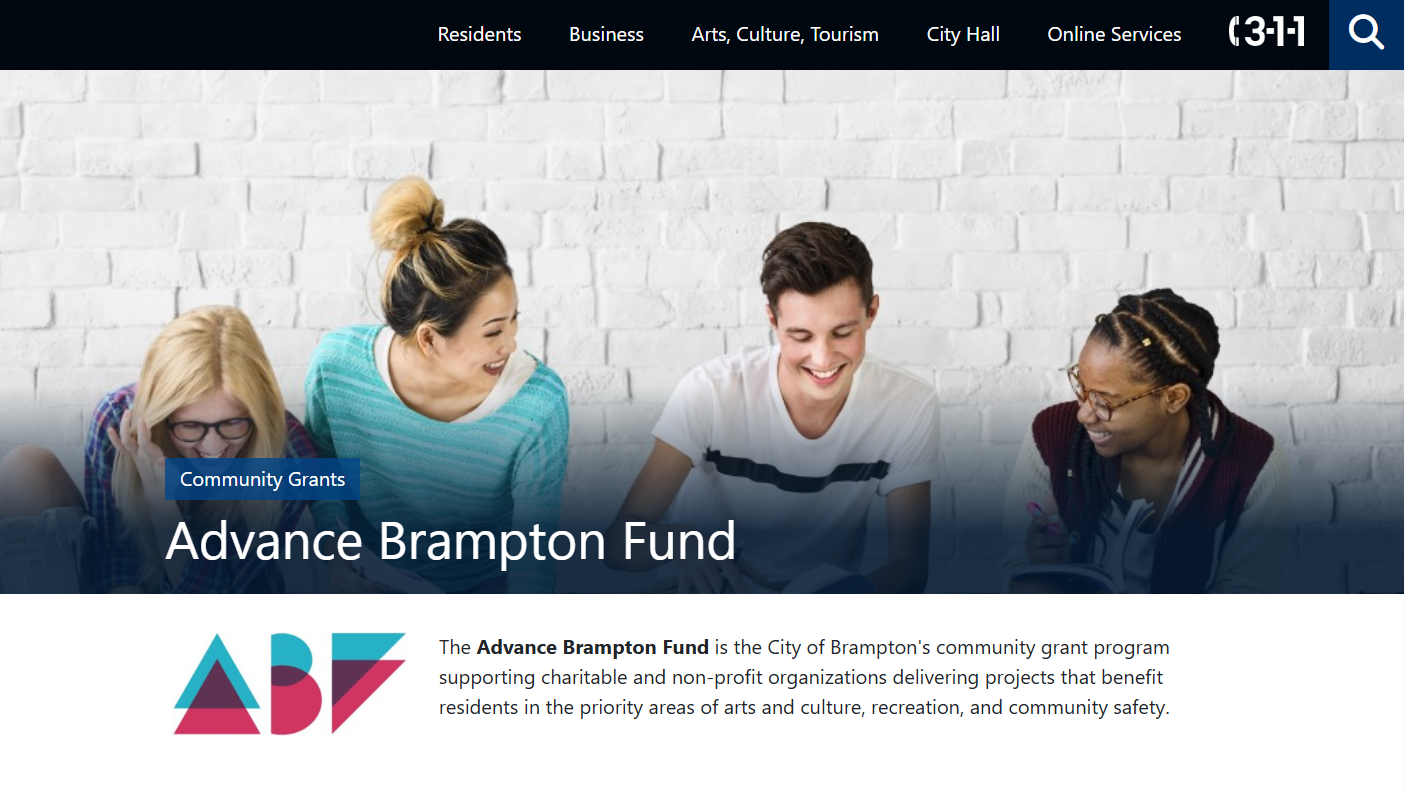
The Community Granting program was also a marquee program that received significant scrutiny from the Office of the Mayor, as well as regional funding bodies, and significant community attention as it used public funds for very large events.
Lastly, as the program was a municipal fund, any redesign of its structures and systems still needed to meet the compliance standards for dispersing public funds with oversight from the municipality’s finance, risk and legal departments, as well as any statutory parameters set forth by the Province of Ontario.

STAFF/SYSTEMS PAIN POINTS
The program was administratively fractured making navigating the journey from I have a question to how do I complete my reporting very difficult for users.
The evaluative model used in the program felt unfair, pitting different sized organizations from very different sectors against one another, making it very difficult for evaluators to judge applications.
The non-profit sector in Brampton was under resourced and underfunded leading non-profits to underperform when sourcing funding both within the program, and also on the regional and national stages.
IMPLEMENTATION & OUTCOMES
After 18 months of research, engagement, service design and council maneuvering, the new framework for the Advance Brampton Fund was ratified by Council and was identified as one of the first major project successfully completed in the Culture Master Plan.
PROGRAM FRAMEWORK: (More below)
The fund was separated into its respective user groups Ensuring that large festivals, sports investment and community projects were no longer competing against each other.
PROGRAM FRAMEWORK IN DETAIL
For each granting stream within the program guides were both digitally and physically printed, supporting in-person information sessions all across the city. The guides were produced to ensure clear, plain language sharing of the necessary details.
Now applicants could clearly see all requirements on the first page, quick glance, of each granting stream, including:
What projects could be funded in the stream.
How much funding was possible per grant
A visual marker of what what grant they were looking at, and how it visually compared to the other granting opportunities - a quick gut check to see if you were considering the ‘right-sized’ opportunity in comparison to your own project, also ensuring that applicants were applying in spaces they could reasonably compare to other entrants.
All important dates
Immediate goals for this stream including which city priorities applicants needed to align their projects.
This way-finding was then also implemented in the online granting portal where applications were submitted.
By aligning the projects being submitted to city priorities, administrators could clearly identify where different strategies were having impact. This created a holistic impact framework that could be updated anytime the city updated its strategies.
ANCILLARY PROGRAMMING FOR NON-PROFITS
The vast majority of non-profits in Brampton are small, grassroots, led by people who have other jobs and are managing families. Learning about board governance, and other management components that are mandated by law as founding member of a non-profit is expensive, time consuming and daunting.
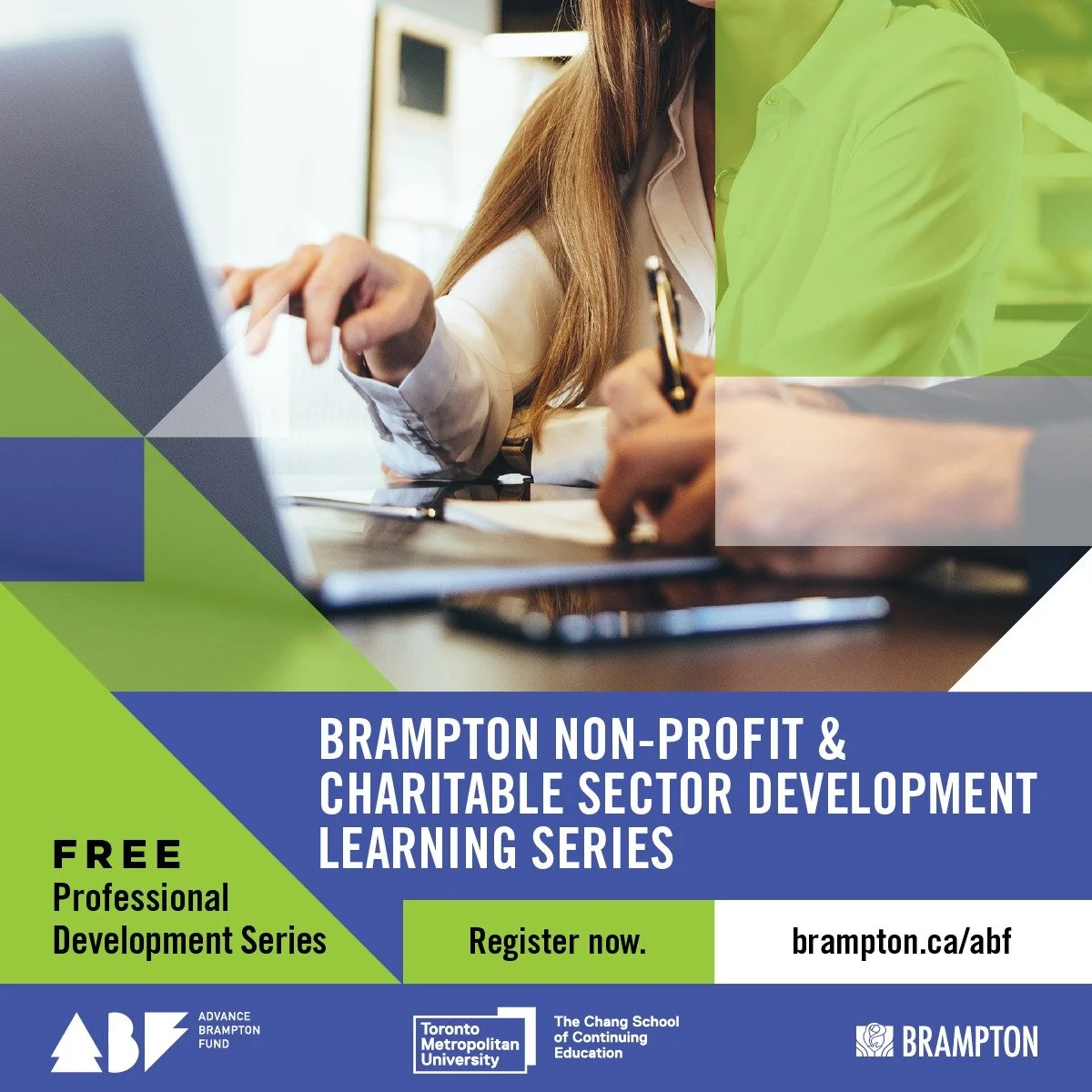
The city funded series, free to participants, was co-designed with Toronto Metropolitan University from their Continuing Education coursework, and adapted with instructors who understood the context of a commuter suburban city - including later in the evening sessions, in-person and virtual sessions, and a community environment where children were welcomed.
In just 3 years between 2020 - 2023, 866 people from community/non-profit/charitable organizations have taken part in the sessions validating the need for this programming in a fast growing city. (Staff Report, May 31st, 2023 at the June 21st, 2023 Council Meeting, under NFP Sector Development - report can be found here.)
Product
Seattle, USA, 2023-2025 (Freelance Contract role, Remote from Toronto)
Design Research, Design Strategy, Prototyping,0-1
ESH is a collective of Social Ventures.
THE IMPACT
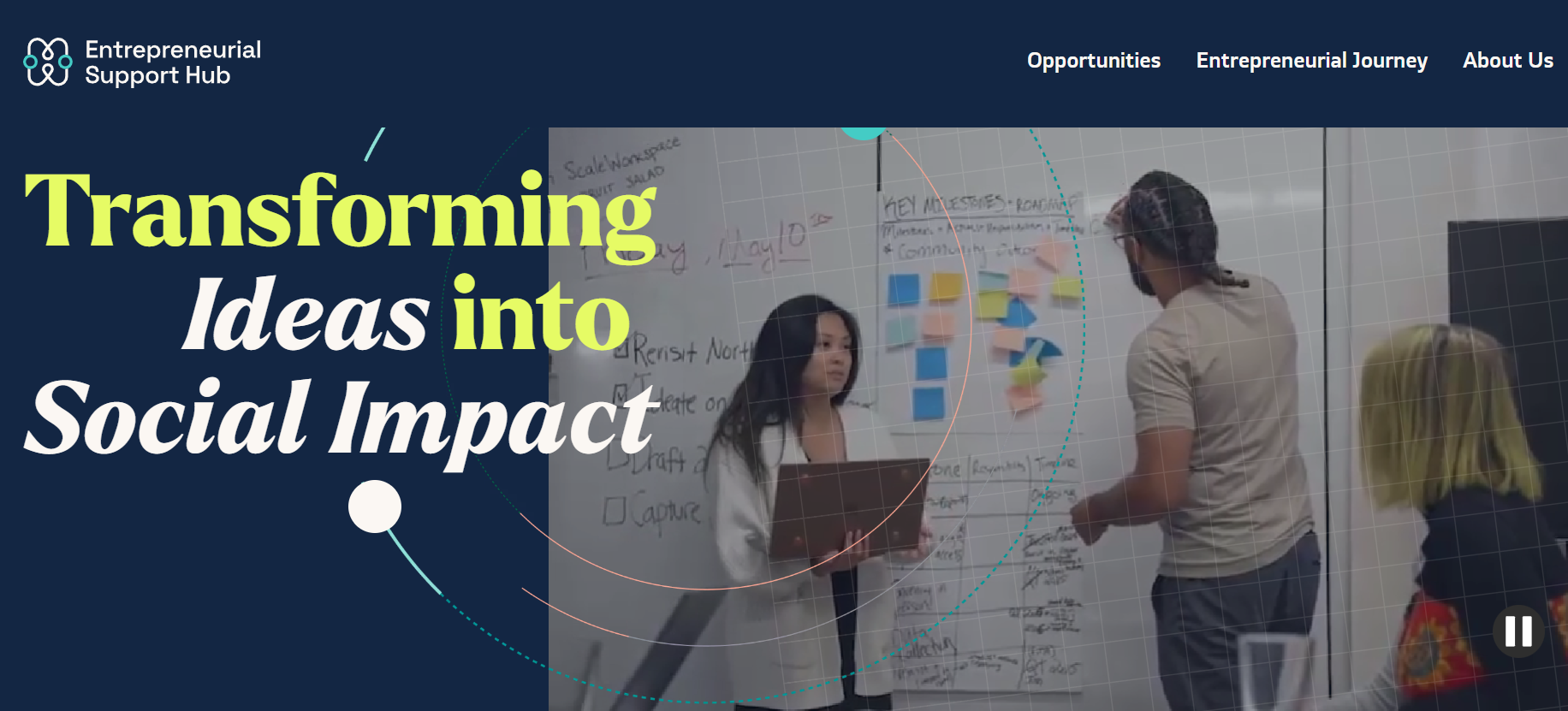
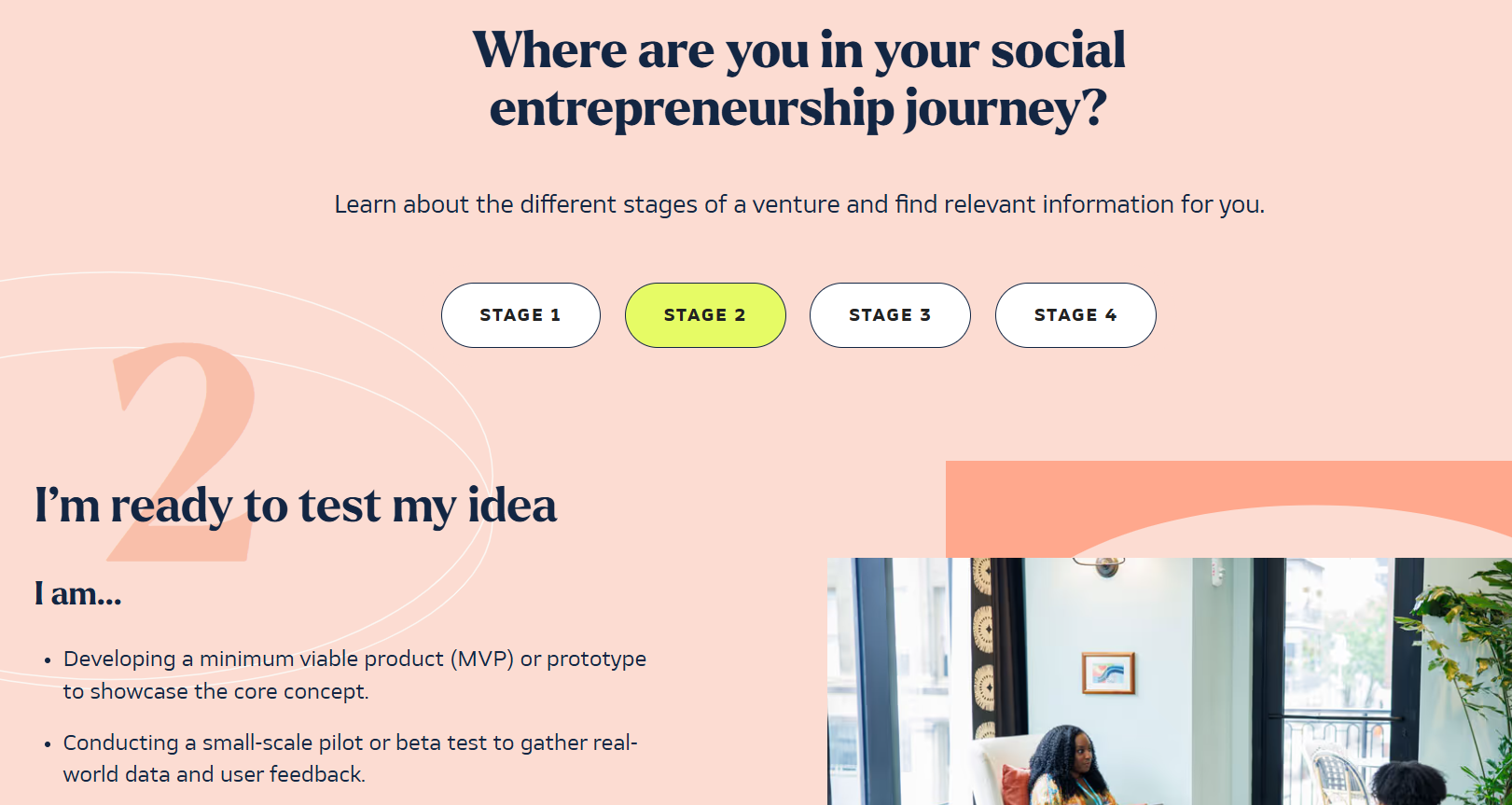
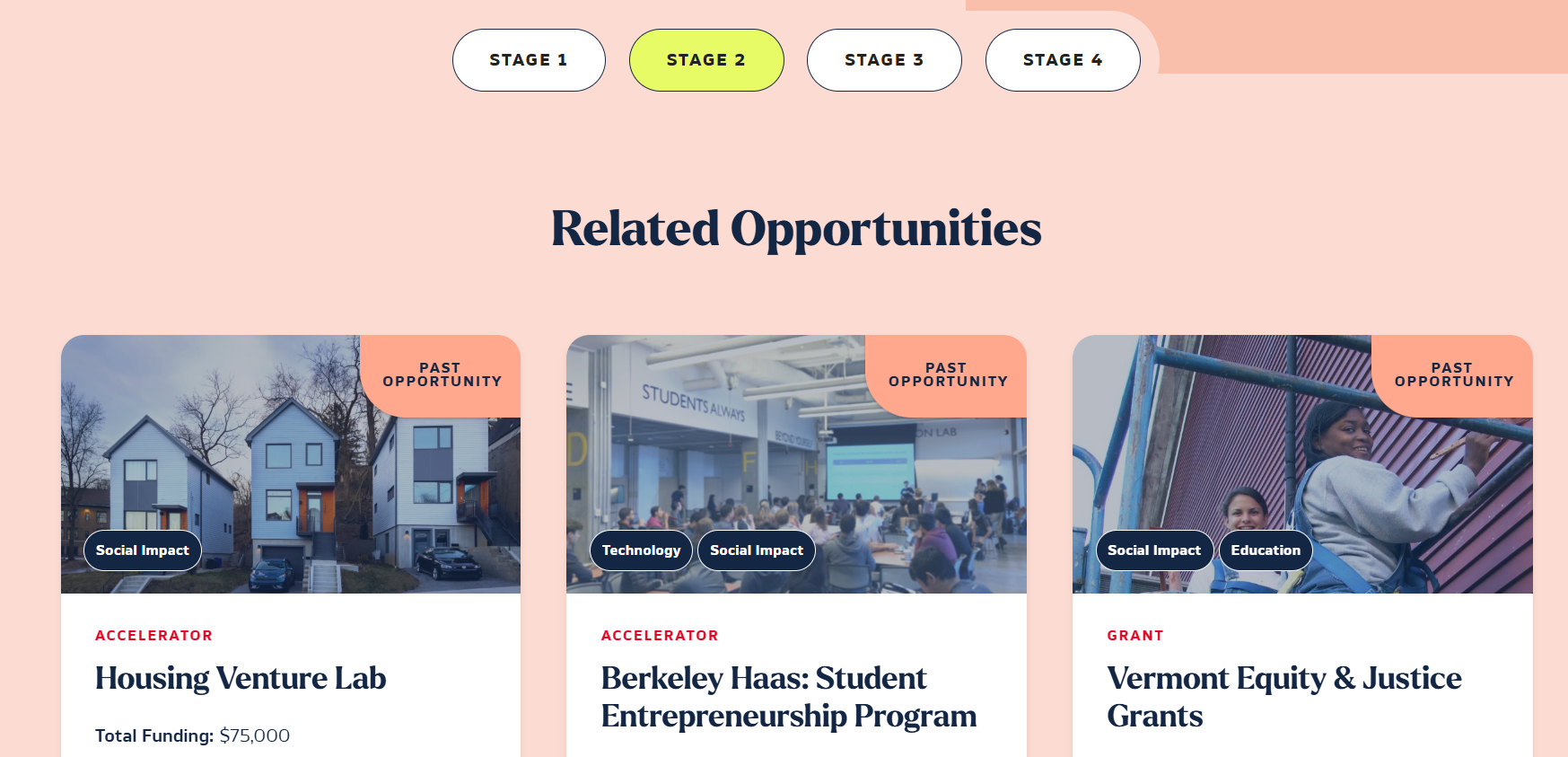
Emerging social entrepreneurs (people with businesses that center both people and profit mandates), now have eshub.org a first of its kind online hub that:
Aggregates millions of dollars of funding opportunities from across the ecosystem, for free into one space,
Provides clear guidance and stepping stones to entry into the social entrepreneurship ecosystem,
Connects them directly to funders (both philanthropic and social venture) to gain insights on the application system, process and what to expect when fundraising for their social venture.
OPPORTUNITY SPACE
Social Entrepreneurs strive to meet both community and commerce goals. Five different social ventures who invest in start-up social enterprises, learned that they are serving the same community members in the US and internationally.
This collective of ventures, (ESH) wanted to know how to best pool their resources to reduce friction in the application process, and ensure accessibility the widest number of potential applicants from the greater the start-up social entrepreneurship ecosystem, with specific focus on serving applicants from equity deserving experiences.
Contracted by Optimistic Design, I led the Design Research and Strategy, including supporting all user research through prototyping.
HIGHLIGHTED APPROACH, METHODS & TOOLS
Inclusive Design Lens applied to qualitative research approach including through participant recruitment, interviewing and synthesis of virtual interviews with participants across the US and Internationally.
Extensive language review and equity audit of all five ventures materials through their application processes; learning about where their practices overlap and where they could share information across ventures.
Review of all five ventures back-end application data and application processes. This acted as an opportunity to benchmark their acceptance rates and consider what applicant personas were most likely to be successful in their systems.
Virtual Workshops with a 360/Holistic Approach with different stakeholders through the start-up social entrepreneur ecosystem including: the ventures themselves, their applicants, applicants who had been declined from any of their programs.
Throughout the research process, participant selection, and creation of research activities and artefacts, we were thoughtfully considering overlapping intersections of identity and power including (but not limited to), class, ethnicity, education attainment and connection to the ventures themselves. This included people who had successfully been funded, and those who had been declined.
INSIGHTS , STRATEGY & PROTYPING
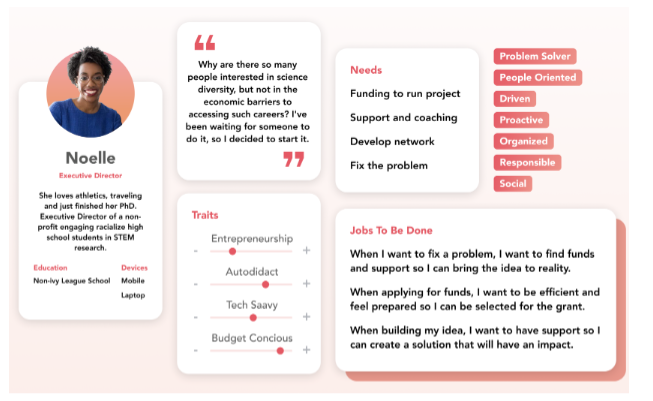
The interviews, workshops and data review surfaced a unique key insight: the Unconnected Applicant.
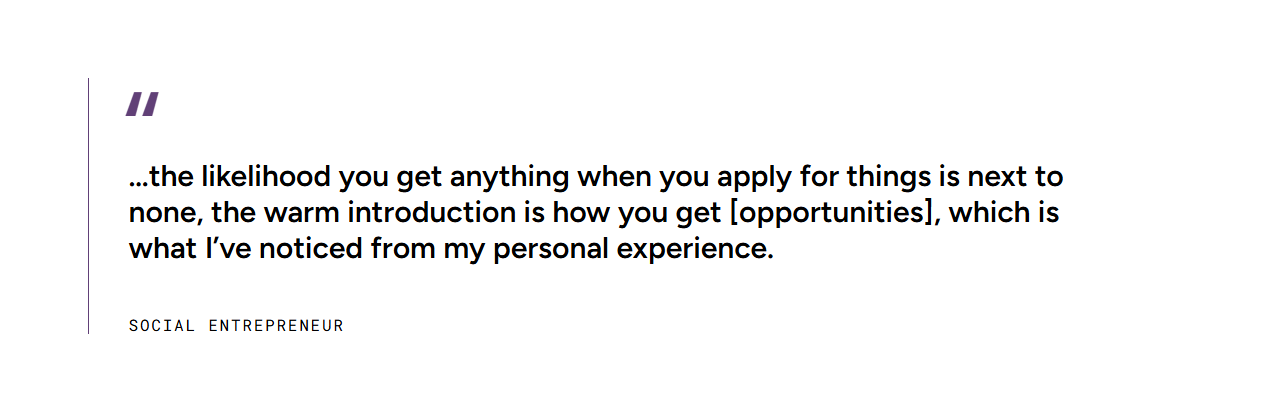
Using extensive ecosystem building and journey mapping, an pattern started to appear - the most successful applicants across the funding ecosystem, had significant networks with the ability to direct them towards potential suitable funders. If an applicant was without network connections to the social entrepreneur ecosystem, their likelihood of being successful within the funding systems was lower.
What also surfaced is the reality of multiple journeys:
The journey to find and apply to funding
The journey of a start-up social entrepreneur
These journeys are inextricably linked, as without clarity on where you are in your business journey (including knowing how to show the social impact of your business), it’s extremely difficult to identify appropriate funding or other resources to support your growth.
Both insights, of being an Unconnected Applicant and having multiple journeys created the opportunity for the prototype to provide clear and distinct features such as an Opportunity Finder, Journey and linking those features so that applicants could clearly see how their stage of business connected to potential funding/resources.
TESTING, IMPLEMENTATION & OUTCOMES
A third party developer moved forward with producing the site, and moved foward with many of the components from the prototype, including a nearly identical Entrepreneur Journey.
I then led the production of a Guidance Document translating the research findings into consistent language for any venture currently within the collective, and to be used for onboarding any ventures in future, ensuring that equitable practices, language and accessibility are centered in their applications and messaging as content was built for the site.
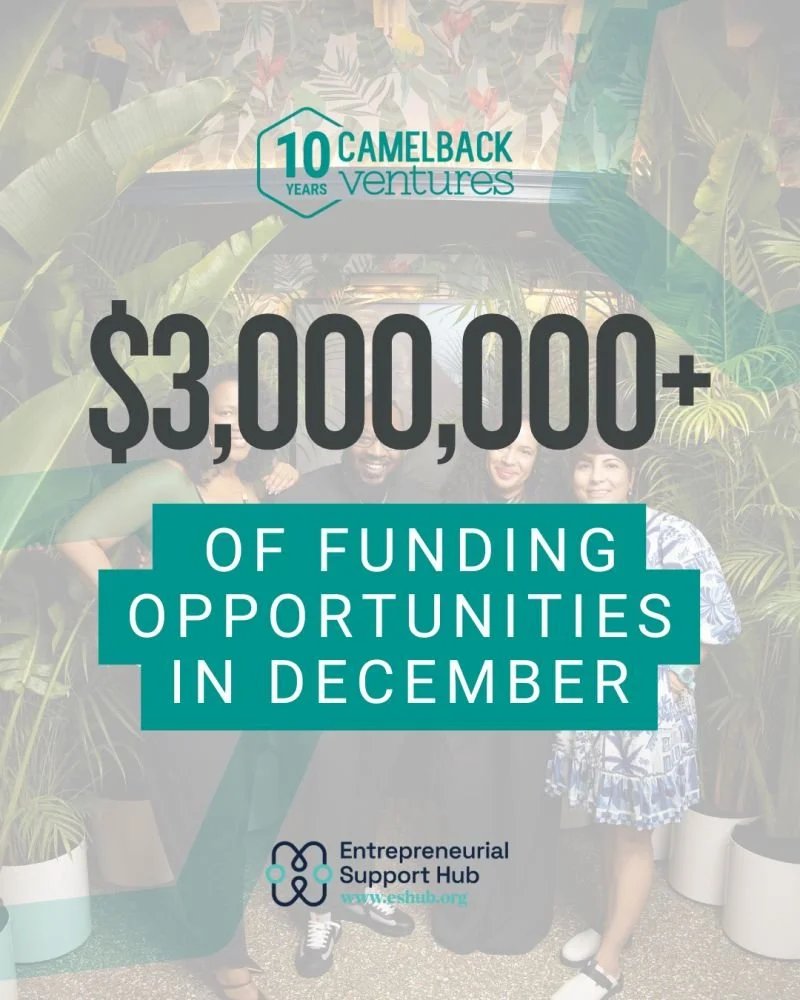
The Entrepreneurial Support Hub (eshub.org) website launched in April 2025 and within two months had 100,000 unique visitors ESH was able to onboard new ventures and funding opportunities, with $3 million dollars (USD) in aggregate opportunities to the site for the month Dec 2025 alone. Camelback Ventures leads the maintenance of the site, and opportunities continue to be added/fluctuate as they arise, with $1 million dollars worth of aggregate opportunities in Jan 2026 available.
TEAM:
Bandana Singh,
Lead Design Researcher & Strategist.Public Documentation
ESHub.org Entrepreneurial Support Hub
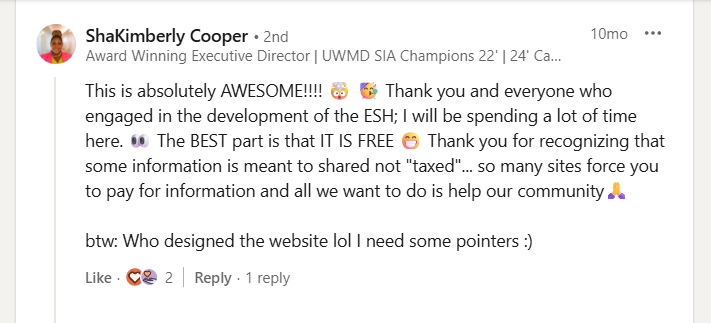
All images copyright of Optimistic Design, except the LinkedIn post (B.Singh Screen shot) and Camelback poster. All images publicly available, and used here only for reference purposes.
Lead Design Firm:
Brand
Vancouver, Canada, 2021-2023 (In house role: In-person + Remote from Toronto)
Design Research, Design Strategy, Rebrand
Tilt is a Curiosity Lab.
THE IMPACT
After 8 years of helping others iterate and dare to think differently, Tilt, a curiosity lab, needed its own reinvention. Leading the (Re)introducing Tilt service and experience design using creative research to refresh the voice, visual identity and program design. The refreshed Tilt:
Won back the interest and sustained loyalty of staff and artists, after negative experiences with the lab in past.
Embedded co-design and users voices into the experience of the activities ensuring each office in a different city had its own voice integrated in the experience.
Created a cohesive, and yet still playful brand experience across multiple formats, online, print, and live events, keeping the spirit of the curiosity lab alive, while creating consistency across assets for both the Tilt staff and for participants in Tilt programming.
OPPORTUNITY SPACE
hcma architecture & design, has always centered play as part of their practice. Tilt is their Curiosity Lab, where they held different activities for staff, artists, researchers, and community members to engage with creative and design experiences outside of their client work.
As a full-time in-house Community Manager & Lead Experience Designer for Tilt, I led the reinvigoration of the service design, program experience, and research for the rebranding of the visual identity.
HIGHLIGHTED APPROACH, METHODS & TOOLS
Framing the research question as: “What if the Lab was a service? Who would it serve? How could it function?”
Creating different user journeys and service blueprints from creative research as a meta approach alongside interviewing - learn about Tilt and its many different users through the types of experiences you might find at Tilt.
This included Love Letters to Tilt, where long standing staff shared what made the Curiosity Lab so special, helping to identify core characteristics of a “mystery sauce” that were essential even if hidden.
This also included an internal digital space and calendar that updated staff across the offices about not only what was happening, but how they could interact directly with the lab, and
Audit of Visual Assets and any documentation which included reviewing and labeling assets such as videos, images, concept briefs and any documentation of previous experiences .
Extensive surveying at both virtual and live Tilt events through the Pandemic. Using pre + post surveys let us document the transformative feeling , any logistical issues, and interest in helping to organize future events.
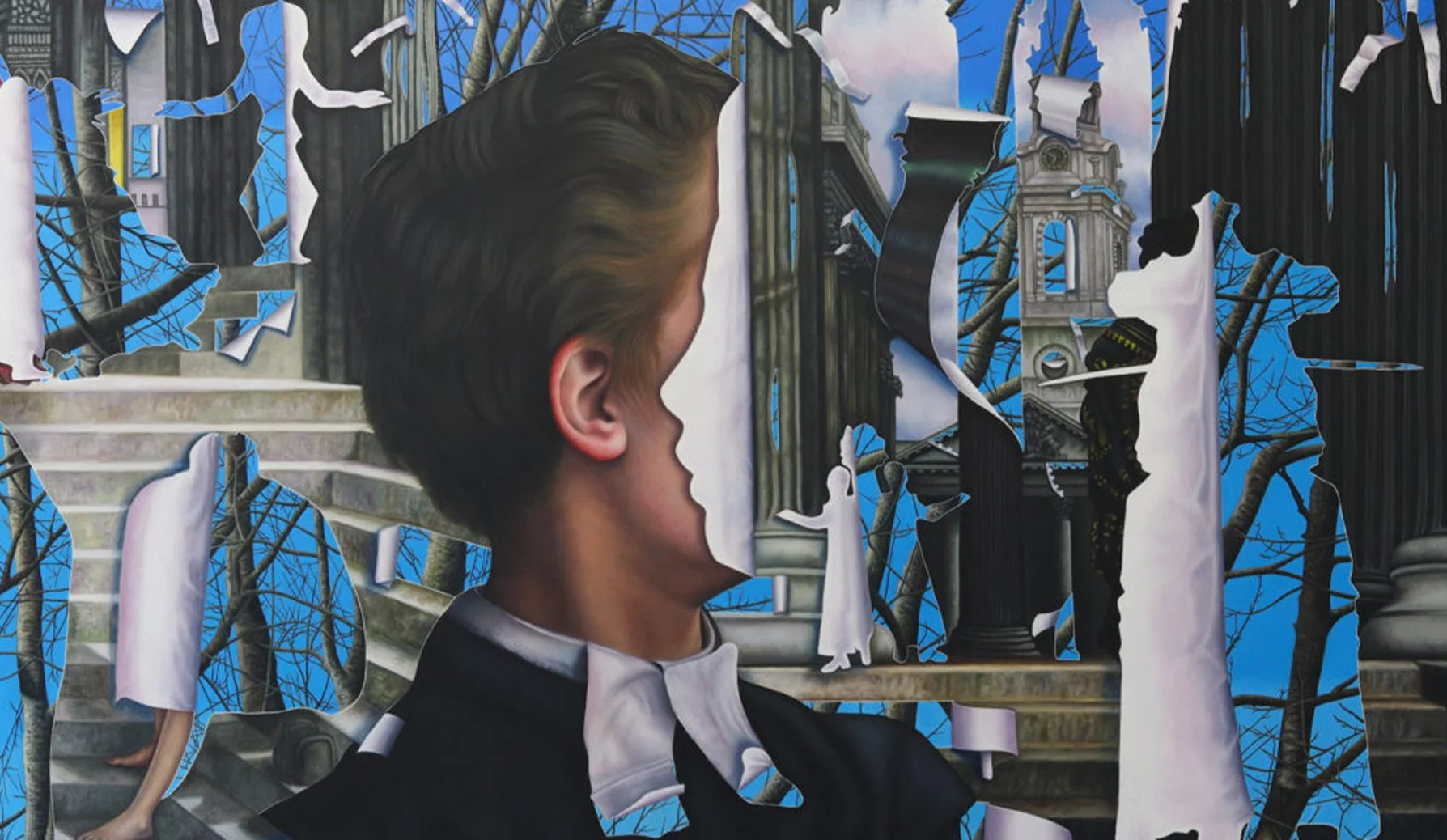
How Tilt was used prior to the rebrand.
INSIGHTS , STRATEGY & PROTYPING
Using creative research methods let participants share how the brand and experience made them feel as part of the hcma ecosystem (across their different areas of work - architecture, design, social impact, operations, etc).
Tilt was simultaneously beloved and contentious amongst both internal and external participants, even if it had a playful brand.
DESIGN RESEARCH INSIGHTS
INSIGHT A: Tilt Participants did not know what to expect at a Tilt activity. Experiences felt random instead of playful, leaving many internal staff confused and occasionally angry when live events would take over their work space during office hours.
INSGHT B: More voices needed to be integrated into Tilt to reflect both the needs of the participants, but also reflect the values of codesign in the activities of the curiosity lab. The original Sr. Leader for Tilt had a very strong, and singular vision for Tilt. Since his departure, the new voice of Tilt was unclear.
INSIGHT B: There were three distinct brands with distinct visual identities competing against each other: hcma, Tilt, and AIR (the Artist in Residence programme), causing significant confusion. Artists mentioned they did not know which entity they were contracted to
TESTING, IMPLEMENTATION & OUTCOMES
The (Re) Introducing Tilt rebrand successfully aligned the service, experience and visual identity of the revived Curiosity Lab with internal brand launch, and renewed staff team to support programming of Tilt initiatives. Tilt also underwent a website redesign and is more deeply integrated in the experiences of the staff to ensure relevance and longevity of the curiosity lab so that staff could continue growing their design and creative inspirations.
TEAM:
Bandana Singh,
Community Manager and Lead Experience DesignerPublic Documentation
“Outside In” by Cara Guri, hcma Tilt, Artist in Residence Vancouver 2021
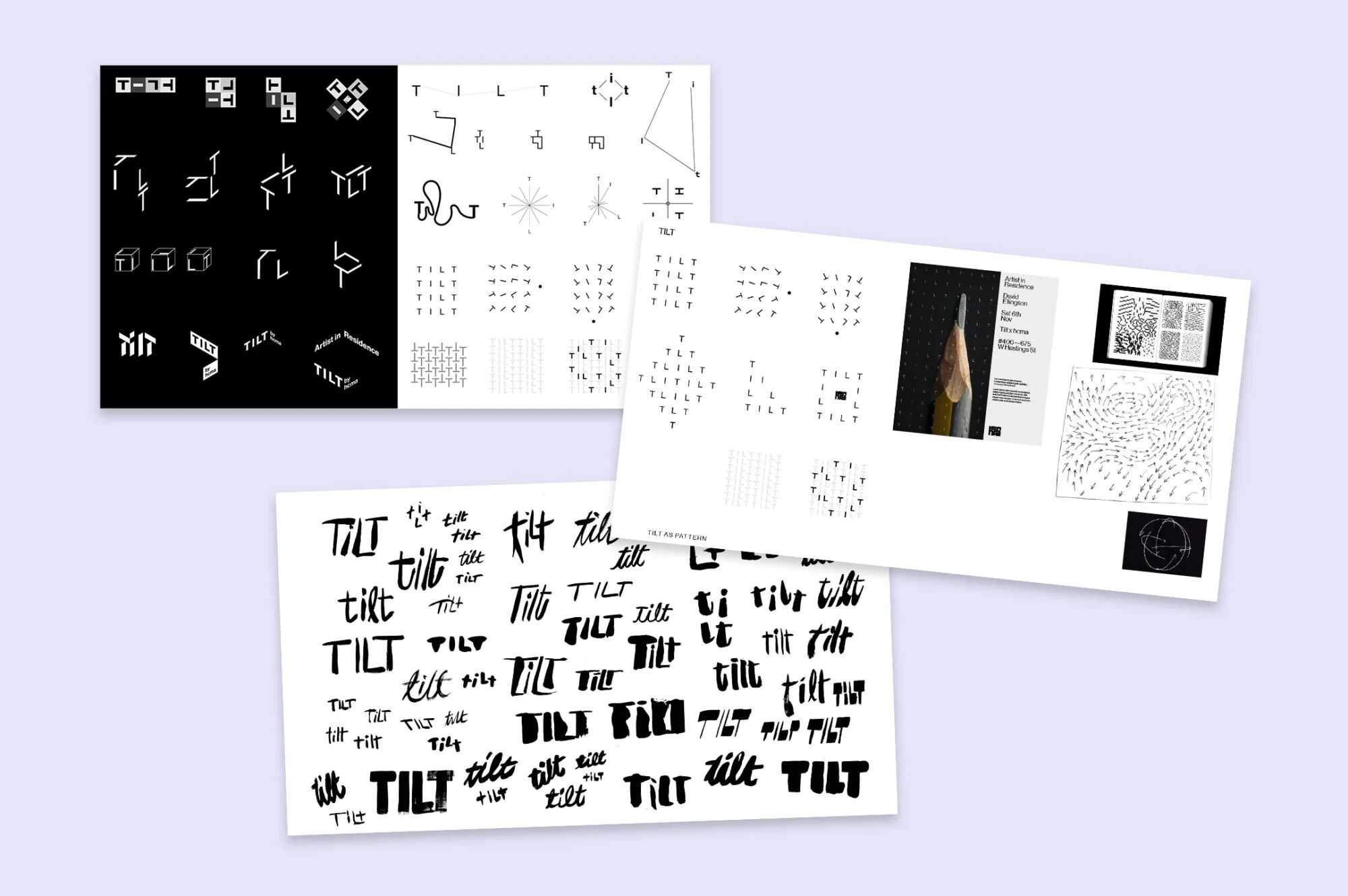
Tilt Brand Identity, Website documentation.
Re-introducing Tilt, Website with Video.
Tilt retrospective (2014-2025) Download PDF
All images copyright of hcma architecure + design, except the photo titled ‘hcma day 2021,’ (B.Singh ). All images and video are publicly available, and used here for reference purposes only.
hcma Marketing & Communications Teams:
Bonnie Retief - Creative Lead (Visual Identity)
Kati Varga- Director of Marketing
Laura Potter - Client Director, Communication Design
Natalie McNeil - Project Manager, Communication Design
Andrea Lee - Operations Coordinator, Tilt Support Team
The Tilt experience and brand began in the head office of Vancouver, but needed to stretch to meet the needs of a growing presence in different cities.
Tilt also was used as a recruitment vehicle to signal the firm’s values to top-talent from all over the world. Tilt had gone defunct by 2020 and was looking to be reinvigorated over the pandemic. hcma’s biggest fear - making Tilt too formalized and losing the playful and ambiguous nature of the experiences.
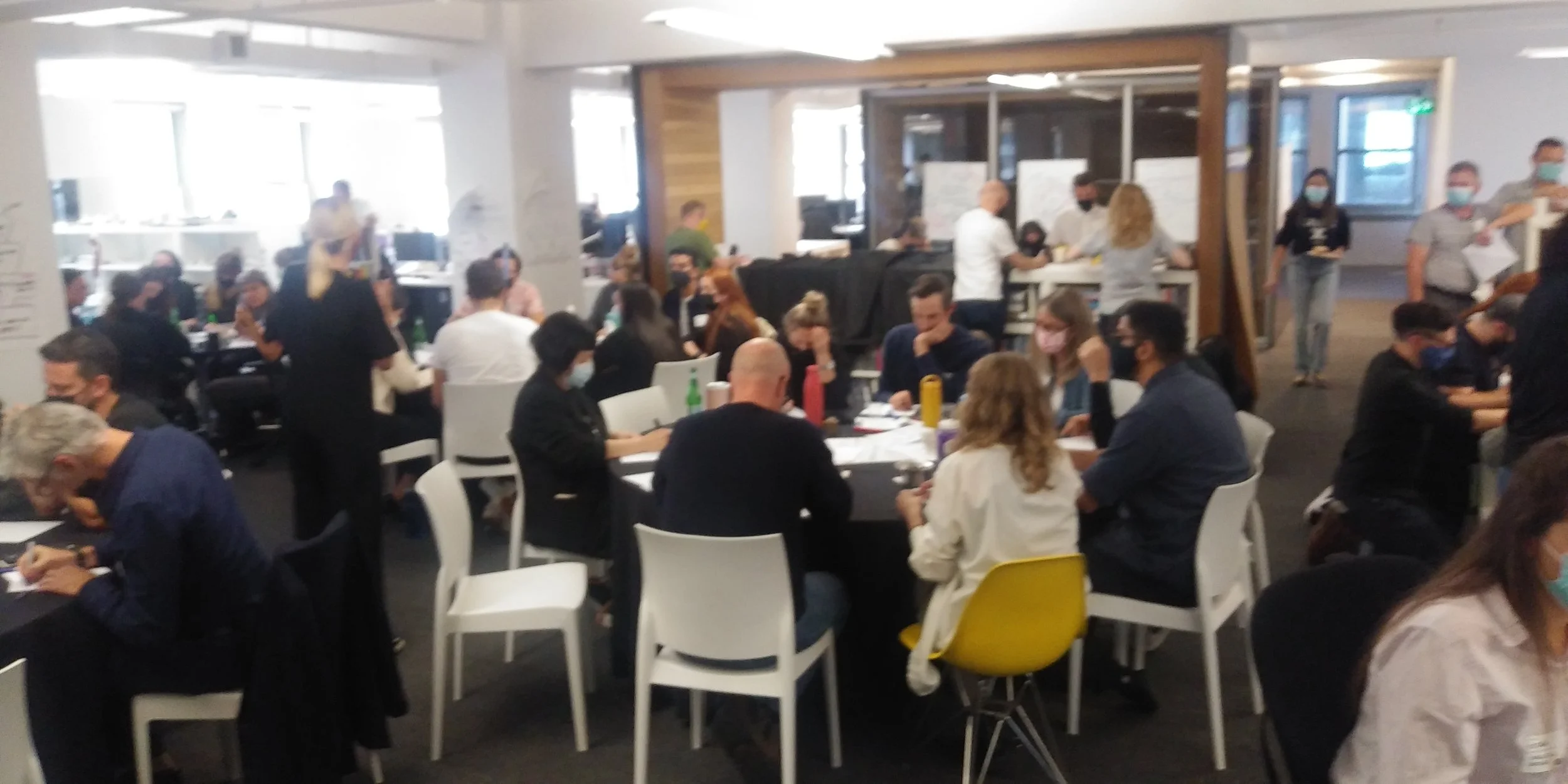
hcma Day 2021 "Constellations of Care," in Vancouver (All Staff, All Day Creative Practice and Inspiration

“Southern Killer Whale, Projections,” by David Ellingson, hcma Tilt, Artist in Residence Victoria 2021
SERVICE RECOMMENDATION
STRATEGY A: Use Core Pillars of Explore, Collaborate and Provoke to ensure accessibility to programming: The design research surfaced three consistent experience archetypes, providing a conceptual scaffolding, instead of a permanent framework. This allows a sense of wayfinding of experiences so a participant (or administrator) can understand why and what they are going to experience or produce in a Tilt project.
STRATEGY B: Tilt’s core users are internal staff, ensure they are centered in the service provisions. By identifying the primary user we were able to ensure long-term buy-in with a core audience who would prioritize Tilt’s rejuvenation and lead its future programming.
STRATEGY C: Align Tilt with the main home brand of hcma, and dissolve AIR into the Tilt visual identity for clarity. The core hcma brand always needed to be easily identifiable for contracting purposes, Tilt became a sub-brand of the hcma core brand, instead of being a stand alone.
How Tilt appears in use after the rebrand.

GoNzO
I really love non-uniformity - anything that’s a mismatch, asymetrical, fuzzy or just plain weird. I play punk and have my own record label, and
I really love working with people, because people are impossible to standardize:
Design that creates the scaffolding for the services we rely on every day, enables all of us more time and space to explore, and imagine what the next version of our world could be.
I’m currently really intrigued by the culture and economy of space exploration. Even after 60 years, we are still asking why and how space exploration can be made more accessible, even though we know that staring at the stars above and asking ‘why’ is the thing that is most innately human.

Problem Space
I attended a public event online led by NASA, “Symposium on the Macroeconomics of Space.” It was convened by Dr. Akil Rao, Interim Cheif Economist.
One of the questions that the economists came across often was “What is important about space exploration?”
That question is really a
Why question.

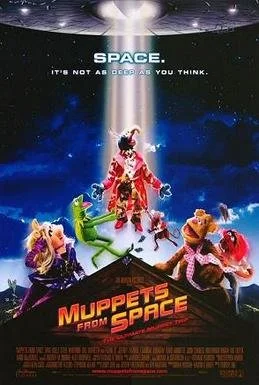
That ‘Why” question made me think of Gonzo the Great! from The Muppets. He is an adventurer, an inventor, and a weirdo. He is the only muppet without a set form - he is called a ‘whatever,’ instead of a frog (like Kermit) or pig (like Ms. Piggy). So Gonzo always wonders where he’s from, and if there’s anyone in the world like him.
It turns out, Gonzo really is from outer space! But when provided the opportunity to return to his planet, he doesn’t go. His home, his ecosystem, are the Muppets - his friends who are each their own weirdos who help him explore the unknown of his core being, his core universe- together they understand their shared “why,” of exploration.
All images are stock from Squarespace, except for the movie poster for ‘Muppets From Space,’ (Jim Henson Productions, Disney). B.Singh has no affiliation with Disney or Jim Henson Production Studios. All images and video are publicly available, and used here for reference purposes only.

“…Sometimes “basic research has larger spillover effects than applied research,” Shawn Kantor (Moonshot: Public R&D and Growth)
The symposium made me think about ecosystems generally. The findings identified how so many different industries participate and change the space economy collectively. The past 25 years have been about building platforms, but now we need more holistic and integrated systems that will provide consistency, longevity and continuity for our economies (space, natural and economic) to continue growing responsibly.



Please note that by applying the password provided and visiting this site, you are agreeing to the following:
You will not share the password to this portfolio with anyone on your team or organization that is not directly a part of the hiring/contracting decision team;
You acknowledge and agree that this content is provided to your team for hiring/contracting purposes only;
You agree to maintain confidentiality of this portfolio not limited to specific content but also processes and methods, and will not share nor disseminate any of the information, images or underlying architecture.